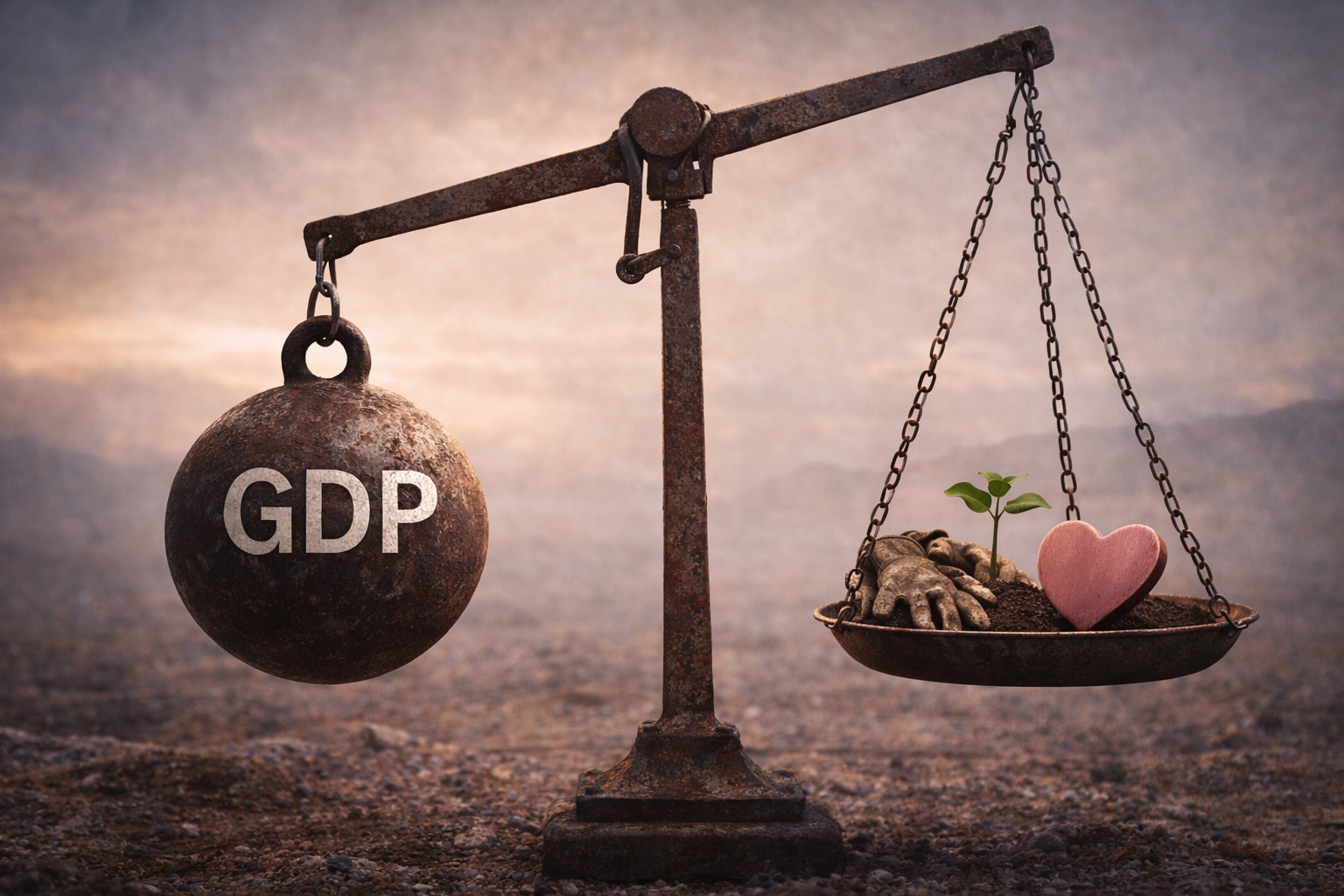
In the early 1940s, the United States needed to answer a specific, urgent question: how much could the country produce for the war effort? The economist Simon Kuznets built GDP to answer exactly that. It was an accounting tool for a nation at war, designed to count output and nothing else.
Kuznets understood the limits of what he'd made. He explicitly warned policymakers against using it as a measure of human welfare. That warning went largely unheeded, and somewhere in the decades that followed, a wartime production gauge became the defining measure of whether a country was succeeding.
The logic GDP inherited from that era never really left. It measures activity, not outcomes. A hurricane tears through a coastline and the cleanup and reconstruction that follow register as growth. A forest standing for centuries contributes nothing to the national accounts. Cut it down and sell the timber, and suddenly it exists economically. Pollution is counted twice over: once when the industrial process creates it, and again when someone is paid to clean it up.
Crime, paradoxically, grows an economy. More crime means more spending on security, legal services, and prisons. A society falling apart in some measurable ways looks, on paper, like one that's thriving.
What doesn't get counted is equally revealing. The parent who leaves work to care for an aging relative disappears from the ledger entirely. Mental health, life satisfaction, the resilience of communities, the state of the environment, how income is actually distributed across a population, none of it registers. Two countries can have identical GDPs while one has a functioning middle class and the other has concentrated wealth and widespread poverty. The number won't tell you which is which.
None of this means economic output is irrelevant. It isn't. But there's a significant difference between a useful instrument and the only instrument. GDP was built for a specific purpose, in a specific moment, by someone who was the first to say it wasn't up to the job we've given it.