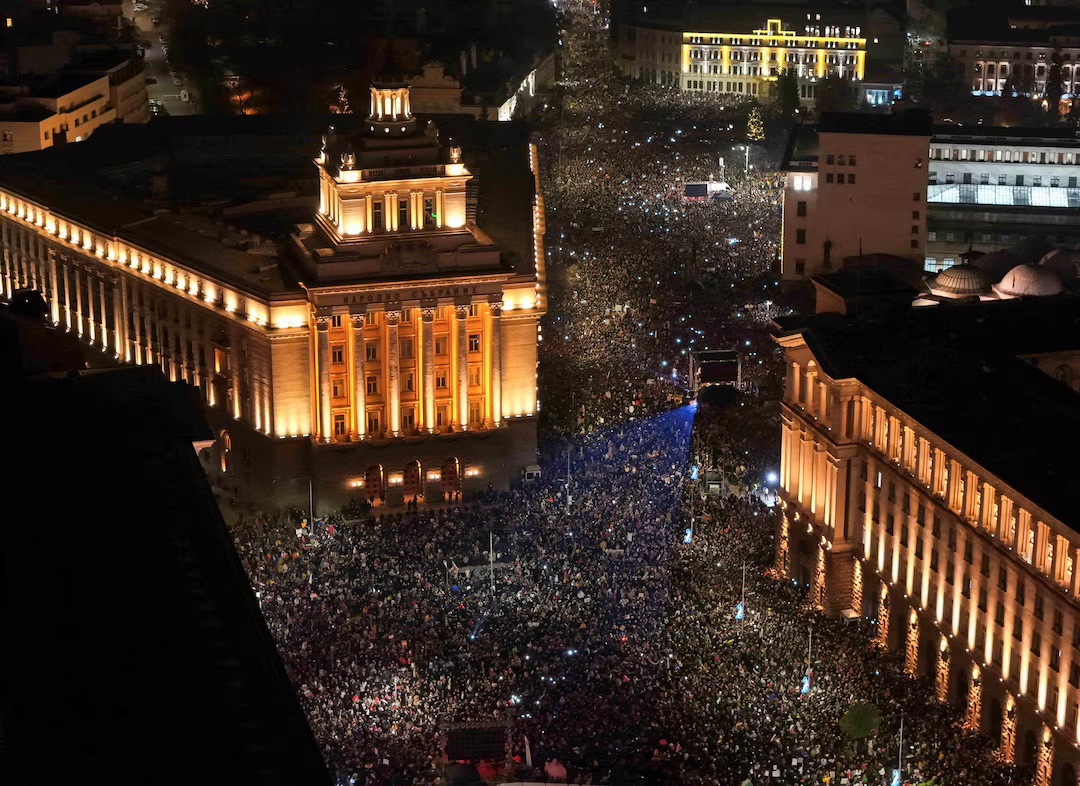
The fundamental crisis of modern society is not a debate over which economic system is superior. We have experimented with capitalism, socialism, and communism in countless variations across continents and centuries. Each has produced moments of prosperity and periods of catastrophe. Each has claimed to hold the answer to human flourishing. Yet every system, regardless of its ideological foundation, has ultimately struggled to provide a universal solution. The left blames the right. The right blames the left. The revolutionaries blame the establishment. The socialists blame the capitalists. The capitalists fight the communists.
What if we are all just arguing over which kitchen tool is best suited for building a skyscraper? We focus entirely on debating the tools, but nobody stops to ask what the actual problem is or why it exists in the first place.
What if the true problem is not ideological but biological, a profound mismatch between the scale of our institutions and the scale of the human species itself?
Humans evolved to thrive in small, close-knit tribes. For over 95% of our history as a species, we lived in bands of 50-150 individuals. This range is known as the Dunbar's Number, the cognitive limit to the number of stable relationships the human brain can genuinely maintain. In this environment, our social instincts were forged. Consensus was organic, emerging naturally from continuous face-to-face conversation around the fire. Trust was built on direct relationships, earned through shared experience and mutual aid rather than abstract systems of credit or contract. Individuals truly cared for one another not because they were morally superior to us, but because survival depended on it. You knew the person you were helping. Their children played with yours. Their well-being was directly tied to the strength of the group.
This was the environment that shaped the human heart. And it is this heart that we now expect to function within institutions of millions and billions.
When any system is forced to organize vast populations, it inevitably breaks down from within. The mechanisms of organic consensus that worked in the tribe become impossible at the scale of the nation-state. They are replaced by rigid ideologies, communism, neoliberalism, nationalism, fundamentalism, that serve as simplified rulebooks for managing the masses. These ideologies are not born from the slow conversation of a community. They are abstract doctrines imposed from above, designed to create order among strangers who will never meet. Where the tribe used social pressure and shared understanding to maintain harmony, the modern state uses laws, bureaucracies, and, ultimately, force.
At this massive scale, it becomes statistically impossible to satisfy the diverse needs of every individual without imposing a rigid framework on the whole. Because we are all inherently different, in our talents, our values, our circumstances, our deepest desires, any standardized system will inevitably conflict with some and marginalize others. The number of possible combinations of human needs and aspirations is near infinite. An ideology is a crude filter that says, "These are the few things that matter most, and if we solve these, everything else will follow." For any given ideology, a significant portion of the population will find that their primary concerns are not among the prioritized few. They become the leftovers, the outliers, the problems to be managed.
Capitalism excels at innovation and efficiency but marginalizes those who exist outside materialistic values, by choice or by circumstance. Socialism excels at providing security but marginalizes the ambitious and creative. Nationalism provides identity and belonging but marginalizes the outsider and the dissenter. No system can capture the full spectrum of human variation. The attempt to do so creates friction, and friction creates heat. Those who are marginalized will fight back, through reform, through revolution, through withdrawal into alternative communities. The system then spends increasing energy on self-preservation and conflict management, energy that could have gone toward human flourishing.
This is not merely a political problem. It is a psychological and spiritual one as well. When trust can no longer be placed in known individuals, it must be placed in abstract systems: currencies that hold value only because we all agree they do, legal contracts enforced by distant courts, credit scores calculated by opaque algorithms, governing institutions staffed by an insular elite whose interests have become a closed circle, severed from the common good. This creates a world of immense complexity and profound fragility. When the system fails, when the bank collapses, when the government shuts down, when the pandemic exposes the brittleness of global supply chains, individuals are left powerless and alone. They have no direct relationships to fall back on, no tribe to gather them in. The social capital that sustained our ancestors through every crisis has been replaced by institutional capital that evaporates the moment the institution falters.
Similarly, empathy itself breaks down at scale. The human heart is not wired to care for millions. It is wired to care for the dozen or so people within arm's reach. When we are asked to extend our concern to distant strangers, our brains simply cannot do it. The suffering of others becomes a statistic, easily ignored or rationalized away. To make sense of the vast sea of anonymous others, we rely on stereotypes and group identities. The out-group is no longer a neighboring tribe we might trade with or marry into; it is an abstract, demonized category. Politics becomes tribal war fought with data and propaganda instead of spears, but the emotional architecture is the same: us against them, friend against enemy, with all the moral complexity of real human beings flattened into caricatures.
We have reached what might be called a governance ceiling, a limit to the scale at which human institutions can function without becoming fundamentally oppressive, inefficient, or alienating. This ceiling is not determined by technology or resources or even political will. It is determined by the architecture of the human brain itself. Our systems have simply grown too large for the hardware they are meant to run on.
If this diagnosis is correct, it demands a radical rethinking of how we organize ourselves. The endless debate between left and right, between more state and less state, between capitalism and socialism, has obscured a more fundamental question: at what scale should power be held? The answer, suggested by our evolutionary history, is that power should be held as locally as possible. The institutions that shape our daily lives, our work, our governance, our economic relationships, should be small enough that the people involved can know one another, trust one another, and hold one another accountable directly.
This is not a call to return to some pre-industrial paradise. We cannot simply disband modern civilization and go back to the tribe. We live in a world of eight billion people facing challenges, climate change, pandemics, global capital flows, that require coordination at scales far beyond the tribal. The task, then, is to build a nested society: one where strong, local, human-scaled communities form the foundation, and larger institutions exist only to handle those problems that cannot be solved locally. The largest structures should be as thin and light as possible, providing coordination without control. The smallest structures should be as thick and rich as possible, providing the belonging, trust, and mutual care that humans require.
This vision takes many possible forms. Bioregionalism would organize economies and polities around natural ecological boundaries rather than arbitrary national borders, allowing communities to manage their own resources sustainably. Cooperative economics would replace multinational corporations with networks of worker-owned enterprises rooted in their communities, accountable to their members rather than distant shareholders. Subsidiarity, the principle that decisions should be made at the most local level capable of handling them, would guide the distribution of political authority. Technology, which has often been a tool of centralization and control, could become a tool of decentralization instead: platforms for participatory democracy, local currencies, mesh networks, open-source manufacturing.
The fundamental debate of our time is not about which ideology should triumph. It is about whether we can recognize that all large-scale ideologies are, by their nature, inadequate to the full complexity of human life. The left and the right have been arguing for centuries about the best way to run a machine that can never work. The real task is not to perfect the machine but to question the need for it, to begin building something that actually fits the human beings who are supposed to live inside it.
We are tribal animals attempting to inhabit industrial-scale institutions. The resulting misery, alienation, and conflict are not accidents or correctable errors. They are symptoms of a fundamental mismatch between our nature and our creations. Until we acknowledge this mismatch and begin to reshape our institutions to match our actual selves, not our idealized visions of what we should be, the crisis will continue. The governance ceiling is real. The only way through it is to build below it.